Free shipping on all orders
Have a question? Text us, and a team member will reply as soon as possible:
(716) 445-9293
Free shipping on all orders
Have a question? Text us, and a team member will reply as soon as possible:
(716) 445-9293
GHK-Cu / BPC-157 / TB-500 · Dermal & Tissue Research
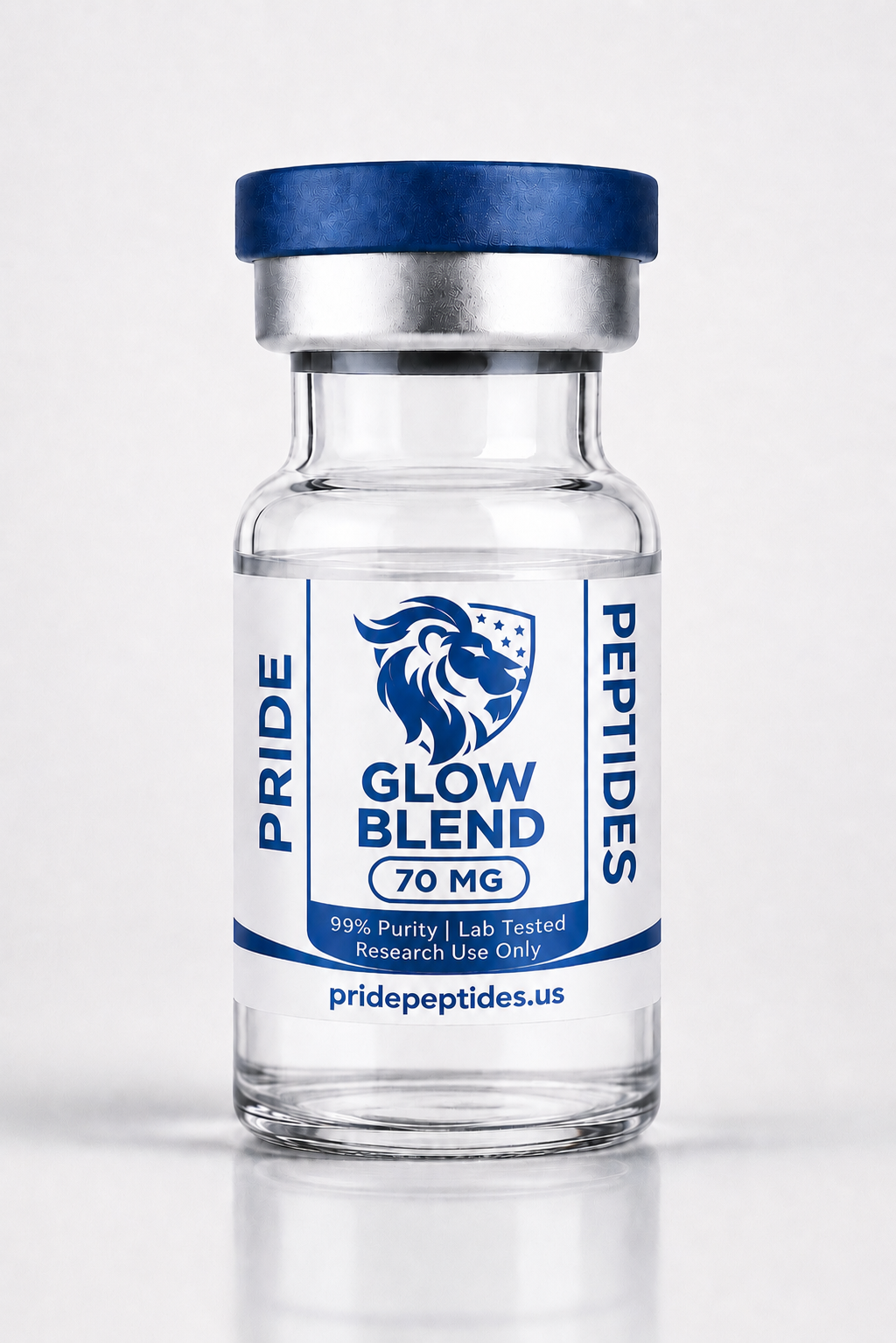
$85.00
Bulk Discount
⚠ RESEARCH USE ONLY
This product is sold strictly for in vitro laboratory research use only. Not for human or animal consumption, diagnostic use, or therapeutic application. Purchasers must be qualified researchers or authorized purchasers for a research institution.
The Glow Blend combines three synthetic peptides frequently studied together in dermal, tissue-repair, and extracellular-matrix research: GHK-Cu, BPC-157, and TB-500. GHK-Cu is a copper-binding tripeptide involved in collagen and matrix biology. BPC-157 is a 15-amino-acid stable gastric pentadecapeptide studied for its influence on tissue-repair signaling. TB-500 is a synthetic fragment of thymosin beta-4 examined for actin dynamics and cell migration.
In research models, this triple-peptide combination is examined for its layered effects on collagen synthesis, angiogenesis, cellular migration, and antioxidant pathway modulation.
Reference: Pickart L. et al. (2015), Oxidative Medicine and Cellular Longevity, 2015, 648108.
Each of the three peptides in the Glow Blend has an independent research history spanning decades. GHK was first isolated from human plasma in 1973 and later characterized as a copper-chaperone with matrix-remodeling effects. BPC-157 was described in the early 1990s by Sikiric and colleagues at the University of Zagreb as a stable fragment derived from a gastric protective compound. Thymosin beta-4, from which TB-500 is derived, was originally isolated in the 1980s from calf thymus and became a widely-studied model for actin-binding cytoskeletal biology. Research combining the three has emerged from interest in layered effects across multiple tissue-repair pathways.
Reference: Pickart L. & Thaler M. M. (1973), Nature New Biology, 243, 85-87.
CAS #: 49557-75-7
Molecular Formula: C14H22CuN6O4
Molecular Weight: 403.93 g/mol
PubChem CID: 71587328
CAS #: 137525-51-0
Molecular Formula: C62H98N16O22
Molecular Weight: 1,419.55 g/mol
PubChem CID: 108101
CAS #: 77591-33-4
Molecular Formula: C212H350N56O78S
Molecular Weight: 4,963.5 g/mol
PubChem CID: 16130571
The three peptides in the Glow Blend have been examined across dermal, wound-repair, angiogenic, and matrix-remodeling research models. Reported findings describe GHK-Cu’s role in collagen synthesis and copper delivery, BPC-157’s effects on angiogenic factor expression and tissue-repair signaling, and TB-500’s involvement in actin sequestration and cellular migration.
Key Areas of Research:
These combined observations position the Glow Blend as a widely-studied research tool for examining layered effects across dermal biology, tissue-repair signaling, and matrix remodeling.
References: Maquart F. X. et al. (1988), FEBS Letters, 238(2), 343-346; Sikiric P. et al. (2018), Current Pharmaceutical Design, 24(18), 1972-1989.
Everything you need to know about our products and processes.
Get the latest on our research peptides
The statements on this website have not been evaluated by the U.S. Food and Drug Administration. The products and information provided by Pride Peptides are not intended to diagnose, treat, cure, or prevent any disease. Pride Peptides LLC is a research chemical supplier. We are not a compounding pharmacy or compounding facility as defined under Section 503A of the Federal Food, Drug, and Cosmetic Act, nor are we an outsourcing facility as defined under Section 503B. All products are sold for research, laboratory, or analytical purposes only, and are not for human consumption.
© 2026. All rights reserved.