Free shipping on all orders
Have a question? Text us, and a team member will reply as soon as possible:
(716) 445-9293
Free shipping on all orders
Have a question? Text us, and a team member will reply as soon as possible:
(716) 445-9293
CAS 2381089-83-2 · Metabolic Research
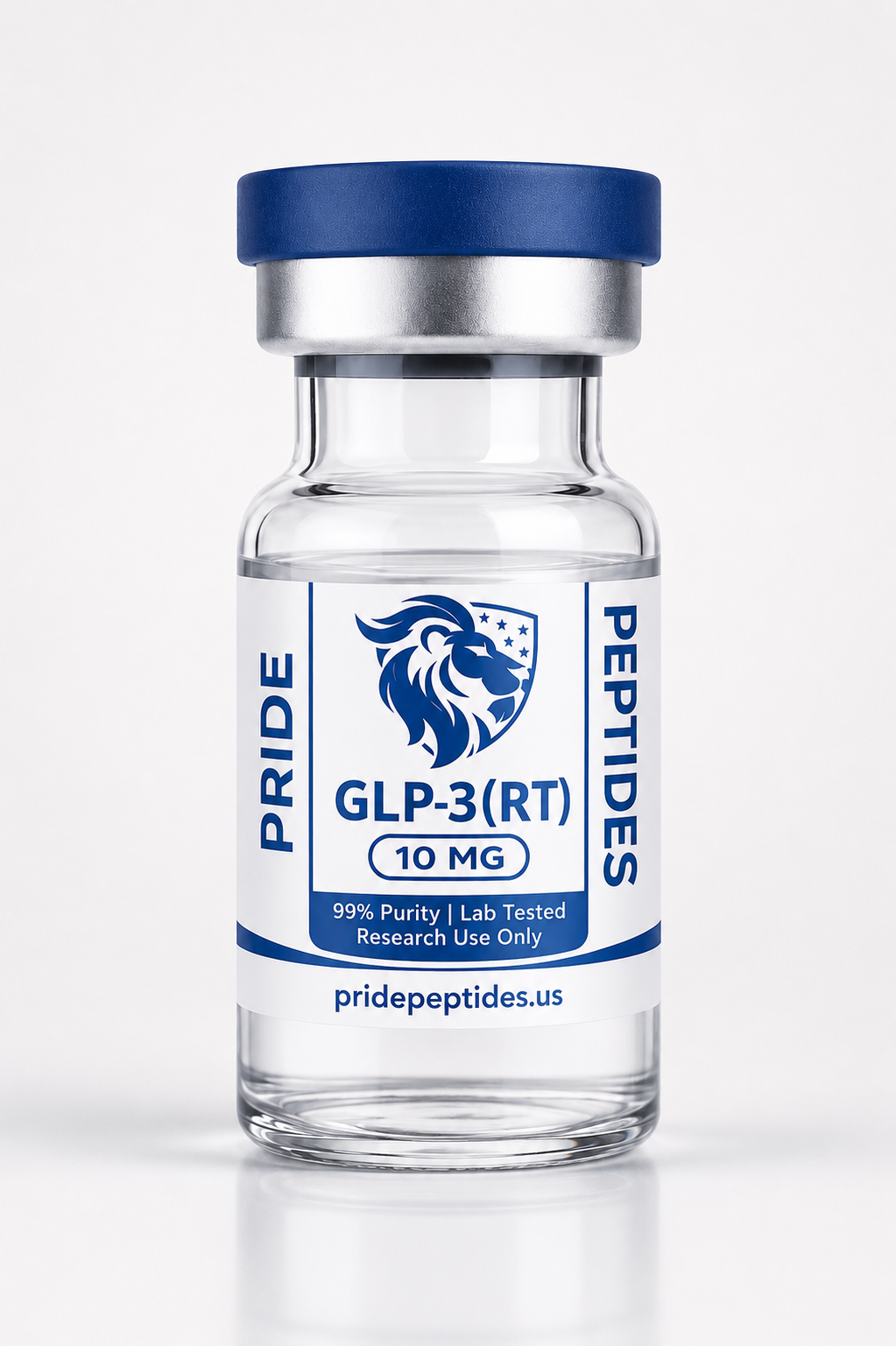
$69.00
Bulk Discount
⚠ RESEARCH USE ONLY
This product is sold strictly for in vitro laboratory research use only. Not for human or animal consumption, diagnostic use, or therapeutic application. Purchasers must be qualified researchers or authorized purchasers for a research institution.
GLP-3 (RT) is a synthetic 39-amino-acid peptide engineered as a triple agonist targeting the glucagon receptor (GCGR), the glucose-dependent insulinotropic polypeptide receptor (GIPR), and the glucagon-like peptide-1 receptor (GLP-1R). Its multi-receptor activity is studied for the way it may model coordinated signaling across three metabolic pathways in a single molecule.
In research models, GLP-3 (RT) has been examined for its role in appetite signaling, gastric-emptying kinetics, insulin secretion pathways, energy expenditure, and hepatic lipid handling.
Reference: Coskun T. et al. (2022), Cell Metabolism, 34(9), 1234-1247.
GLP-3 (RT) emerged from research programs exploring polypharmacology at incretin receptors. Building on decades of study of GLP-1 and GIP biology, and the rediscovery of glucagon’s role in energy balance, the molecule was designed to activate all three receptors from a single sequence. Early preclinical work reported in the peer-reviewed literature (2022) described its receptor-binding profile and its use as a tool compound in metabolic research.
Reference: Urva S. et al. (2022), Clinical Pharmacokinetics, 61, 1057-1069.
CAS #: 2381089-83-2
Molecular Formula: C221H342N46O68
Molecular Weight: 4,731.33 g/mol
PubChem CID: 171390338
GLP-3 (RT) has been studied in preclinical rodent and non-human primate models, as well as early-phase human research settings. Reported findings describe simultaneous activity at three metabolic receptors, coordinated effects on food intake, glucose handling, and energy expenditure, and dose-dependent changes in body composition across published research.
Key Areas of Research:
These converging observations make GLP-3 (RT) a widely-used research tool for studying how multi-receptor peptide agonists coordinate signaling across the incretin, glucagon, and GIP axes.
References: Jastreboff A. M. et al. (2023), NEJM, 389, 514-526; Rosenstock J. et al. (2023), The Lancet, 402(10401), 529-544.
Everything you need to know about our products and processes.
Get the latest on our research peptides
The statements on this website have not been evaluated by the U.S. Food and Drug Administration. The products and information provided by Pride Peptides are not intended to diagnose, treat, cure, or prevent any disease. Pride Peptides LLC is a research chemical supplier. We are not a compounding pharmacy or compounding facility as defined under Section 503A of the Federal Food, Drug, and Cosmetic Act, nor are we an outsourcing facility as defined under Section 503B. All products are sold for research, laboratory, or analytical purposes only, and are not for human consumption.
© 2026. All rights reserved.