Free shipping on all orders
Have a question? Text us, and a team member will reply as soon as possible:
(716) 445-9293
Free shipping on all orders
Have a question? Text us, and a team member will reply as soon as possible:
(716) 445-9293
CAS 946870-92-4 · Endocrine Research
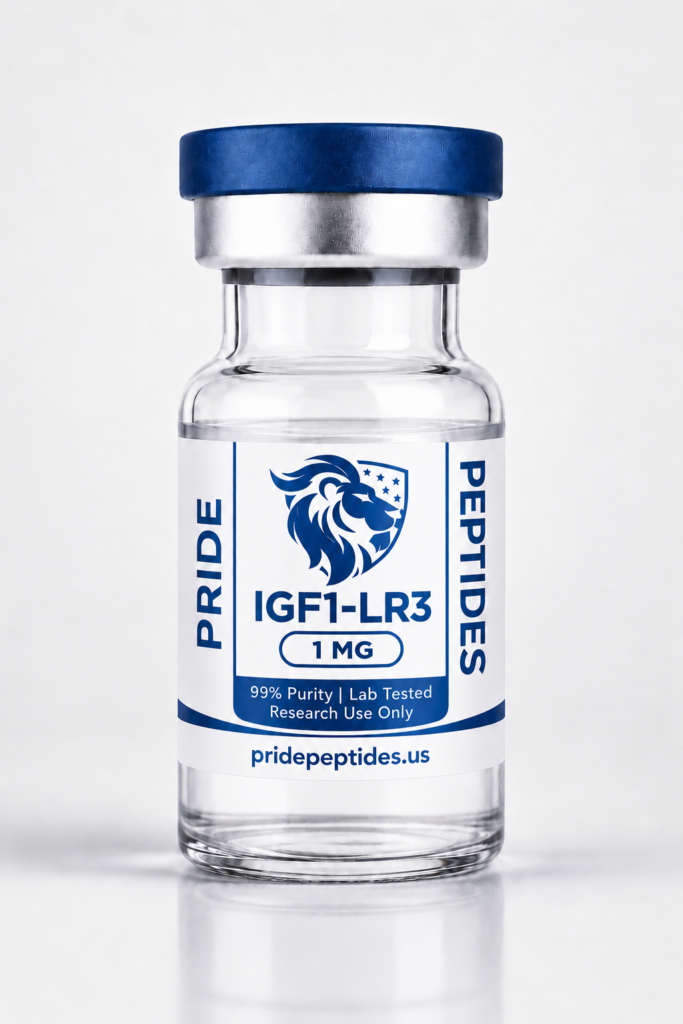
$69.00
Bulk Discount
⚠ RESEARCH USE ONLY
This product is sold strictly for in vitro laboratory research use only. Not for human or animal consumption, diagnostic use, or therapeutic application. Purchasers must be qualified researchers or authorized purchasers for a research institution.
CERTIFICATE OF ANALYSIS
Third party tested for: Purity · ID · Quantity
IGF1-LR3 (Long R3 insulin-like growth factor-I) is an 83-amino-acid synthetic analog of human IGF-1. It carries a glutamic acid-to-arginine substitution at position 3 and a 13-amino-acid N-terminal extension, modifications that sharply reduce binding to IGF-binding proteins (IGFBPs).
In research models, IGF1-LR3 has been examined for IGF-1 receptor signaling, cell proliferation and survival pathways, myoblast differentiation, and as a potent growth supplement in serum-free cell culture systems.
Reference: Tomas F. M. et al. (1996), J Endocrinol, 150(1), 77-84.
Native IGF-1 was first described in the 1950s as a serum “sulfation factor” and later characterized as somatomedin C, with its amino-acid sequence determined in 1978. Because IGFBPs limit the activity of native IGF-1 in culture, analogs with reduced IGFBP affinity were developed. The Long R3 variant was engineered in the early 1990s and became widely used in biopharmaceutical cell culture and growth-factor signaling research.
Reference: Garnaut S. M. et al. (2002), Growth Factors, 20(1), 17-25.
CAS #: 946870-92-4
Molecular Formula: C400H625N111O115S9
Molecular Weight: ~9,111 g/mol
IGF1-LR3 has primarily been studied in cell culture and preclinical models. Published work centers on activation of the IGF-1 receptor and its downstream PI3K/Akt and MAPK/ERK pathways, and on how reduced IGFBP binding changes potency relative to native IGF-1.
Key Areas of Research:
These characteristics make IGF1-LR3 a widely used research tool for studying growth-factor signaling and IGFBP biology.
References: Garnaut S. M. et al. (2002), Growth Factors, 20(1), 17-25.; Tomas F. M. et al. (1996), J Endocrinol, 150(1), 77-84.
Everything you need to know about our products and processes.
Get the latest on our research peptides
The statements on this website have not been evaluated by the U.S. Food and Drug Administration. The products and information provided by Pride Peptides are not intended to diagnose, treat, cure, or prevent any disease. Pride Peptides LLC is a research chemical supplier. We are not a compounding pharmacy or compounding facility as defined under Section 503A of the Federal Food, Drug, and Cosmetic Act, nor are we an outsourcing facility as defined under Section 503B. All products are sold for research, laboratory, or analytical purposes only, and are not for human consumption.
© 2026. All rights reserved.