Free shipping on all orders
Have a question? Text us, and a team member will reply as soon as possible:
(716) 445-9293
Free shipping on all orders
Have a question? Text us, and a team member will reply as soon as possible:
(716) 445-9293
CAS 49557-75-7 · Tissue Research
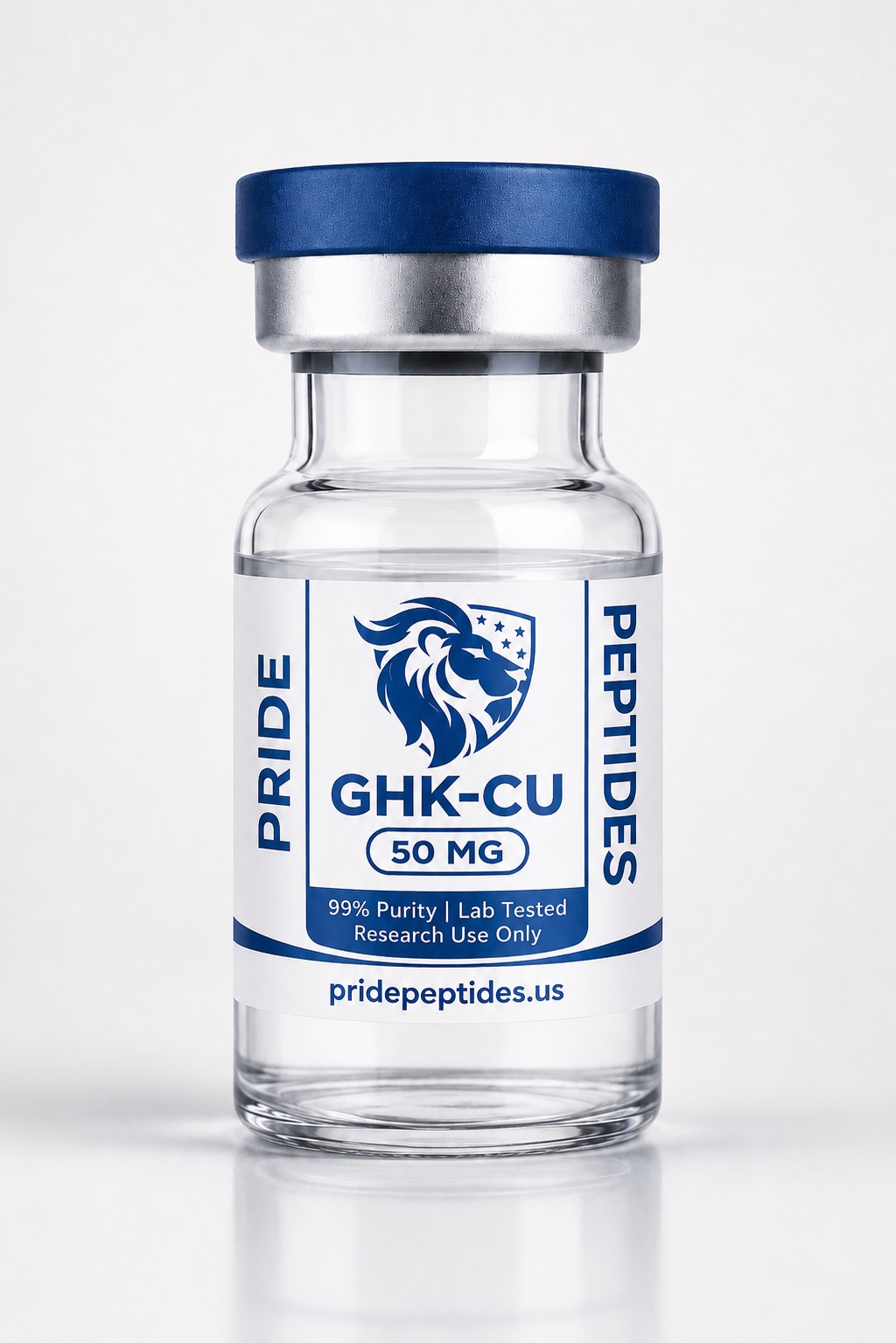
$35.00
Bulk Discount
⚠ RESEARCH USE ONLY
This product is sold strictly for in vitro laboratory research use only. Not for human or animal consumption, diagnostic use, or therapeutic application. Purchasers must be qualified researchers or authorized purchasers for a research institution.
GHK-Cu is a naturally occurring copper-binding tripeptide composed of glycine, L-histidine, and L-lysine (Gly-His-Lys) coordinated with a copper(II) ion. It was first isolated from human plasma in 1973, and levels have been observed to decline with age. Its copper-dependent activity is studied in fibroblast and tissue-repair models for its influence on collagen synthesis, glycosaminoglycan production, and extracellular matrix remodeling.
In research models, GHK-Cu has been examined for its modulation of matrix metalloproteinase expression, antioxidant pathway activation, and its broad influence on tissue-repair gene expression networks.
Reference: Pickart L. & Thaler M. M. (1973), Nature New Biology, 243, 85-87.
GHK was first identified by Pickart and Thaler in 1973 as a growth factor found in human plasma. Subsequent research through the 1980s established its high affinity for copper and characterized the GHK-Cu complex as biologically distinct from the free peptide. Later gene-expression studies published by Pickart and colleagues described GHK’s modulation of thousands of human genes concentrated in tissue-repair, antioxidant, and anti-inflammatory pathways, making it a widely-studied tool compound in regenerative research.
Reference: Pickart L. et al. (2012), BioMed Research International, 2012, 324832.
CAS #: 49557-75-7 (Cu complex: 89030-95-5)
Molecular Formula: C14H22CuN6O4
Molecular Weight: 403.93 g/mol
PubChem CID: 71587328
GHK-Cu has been examined across dermal, wound-repair, and tissue-remodeling research models. Reported observations describe copper-dependent effects on fibroblast collagen synthesis with maximal effect at nanomolar concentrations, modulation of matrix metalloproteinase expression, and stimulation of glycosaminoglycan synthesis in cultured dermal cells.
Key Areas of Research:
These findings position GHK-Cu as a widely-used research tool for studying copper-dependent extracellular matrix biology and gene-expression networks in tissue-repair research.
References: Maquart F. X. et al. (1988), FEBS Letters, 238(2), 343-346; Pickart L. et al. (2015), Oxidative Medicine and Cellular Longevity, 2015, 648108.
Everything you need to know about our products and processes.
Get the latest on our research peptides
The statements on this website have not been evaluated by the U.S. Food and Drug Administration. The products and information provided by Pride Peptides are not intended to diagnose, treat, cure, or prevent any disease. Pride Peptides LLC is a research chemical supplier. We are not a compounding pharmacy or compounding facility as defined under Section 503A of the Federal Food, Drug, and Cosmetic Act, nor are we an outsourcing facility as defined under Section 503B. All products are sold for research, laboratory, or analytical purposes only, and are not for human consumption.
© 2026. All rights reserved.