Free shipping on all orders
Have a question? Text us, and a team member will reply as soon as possible:
(716) 445-9293
Free shipping on all orders
Have a question? Text us, and a team member will reply as soon as possible:
(716) 445-9293
CAS 53-84-9 · Mitochondrial Research
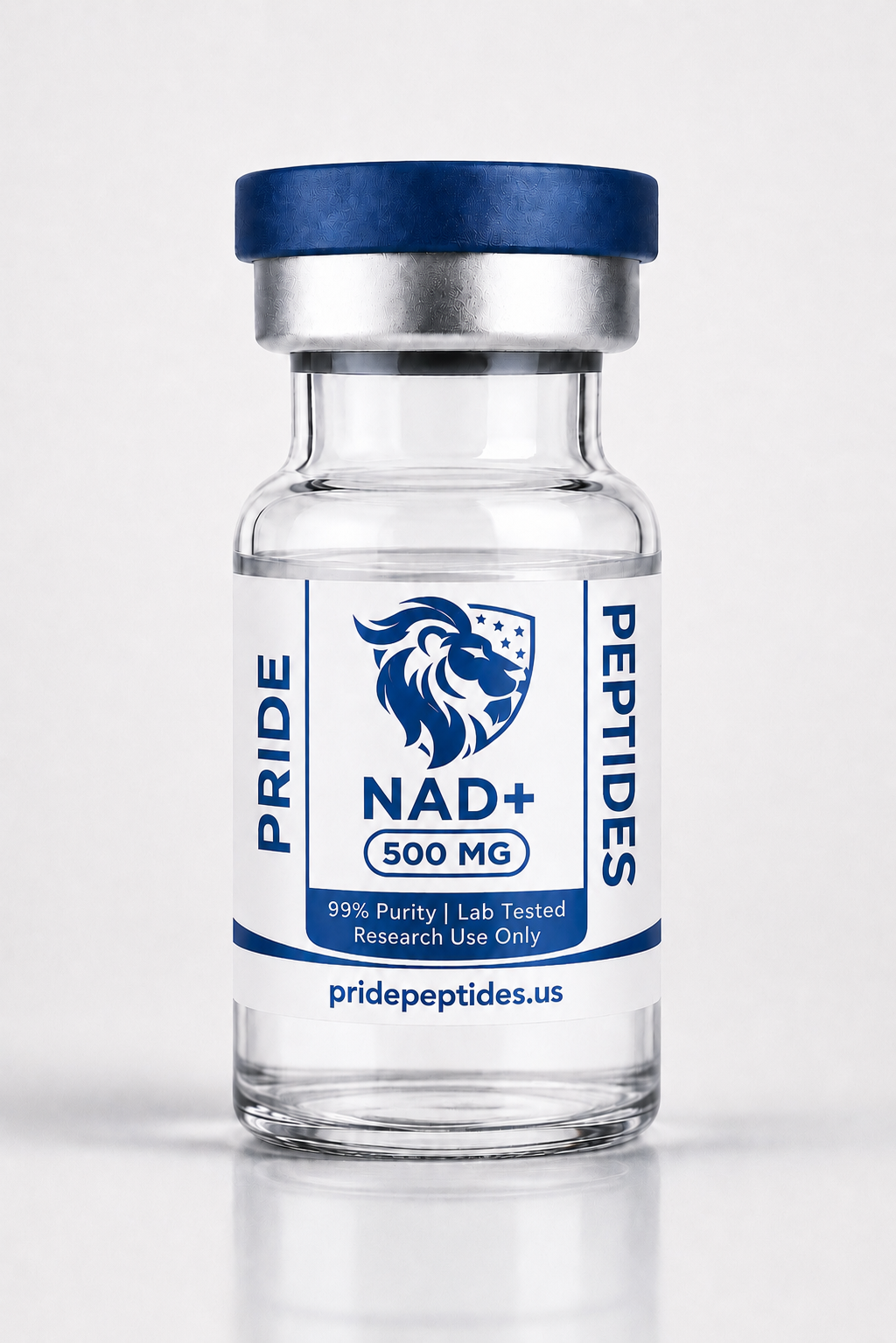
$65.00
Bulk Discount
⚠ RESEARCH USE ONLY
This product is sold strictly for in vitro laboratory research use only. Not for human or animal consumption, diagnostic use, or therapeutic application. Purchasers must be qualified researchers or authorized purchasers for a research institution.
NAD+ (nicotinamide adenine dinucleotide) is a fundamental coenzyme found in every living cell, central to redox reactions, electron transport, and a broad range of cellular signaling pathways. It functions as a substrate for sirtuins, PARPs, and CD38 enzymes, positioning it at the intersection of metabolic regulation, DNA repair, and cellular aging research.
In research models, NAD+ has been examined for its role in mitochondrial function, sirtuin-mediated deacetylation, age-related NAD+ decline, and cellular energy homeostasis.
NAD+ was first discovered in 1906 by Sir Arthur Harden and William John Young while studying yeast fermentation, though its role wasn’t fully characterized until Otto Warburg’s work in the 1930s established it as a hydrogen-carrying coenzyme. Later research through the mid-20th century revealed its central role in the electron transport chain and glycolysis. The modern era of NAD+ research began in the early 2000s with the identification of sirtuins as NAD+-dependent deacetylases, followed by the discovery of age-related NAD+ decline, which has fueled ongoing interest in the coenzyme as a target of cellular-aging research.
Reference: Imai S. & Guarente L. (2014), Trends in Cell Biology, 24(8), 464-471.
CAS #: 53-84-9
Molecular Formula: C21H27N7O14P2
Molecular Weight: 663.43 g/mol
PubChem CID: 5892
NAD+ has been examined across metabolic, mitochondrial, DNA-repair, and cellular-aging research models. Reported findings describe its role as a sirtuin cofactor in deacetylation reactions, its involvement in PARP-mediated DNA damage response, mitochondrial biogenesis regulation via SIRT1-PGC-1α signaling, and the observed decline of tissue NAD+ levels with advancing age in mammalian models.
Key Areas of Research:
These findings make NAD+ one of the most widely-studied coenzymes in modern cellular-aging and metabolic research.
References: Yoshino J. et al. (2018), Cell Metabolism, 27(3), 513-528; Rajman L. et al. (2018), Cell Metabolism, 27(3), 529-547.
Everything you need to know about our products and processes.
Get the latest on our research peptides
The statements on this website have not been evaluated by the U.S. Food and Drug Administration. The products and information provided by Pride Peptides are not intended to diagnose, treat, cure, or prevent any disease. Pride Peptides LLC is a research chemical supplier. We are not a compounding pharmacy or compounding facility as defined under Section 503A of the Federal Food, Drug, and Cosmetic Act, nor are we an outsourcing facility as defined under Section 503B. All products are sold for research, laboratory, or analytical purposes only, and are not for human consumption.
© 2026. All rights reserved.